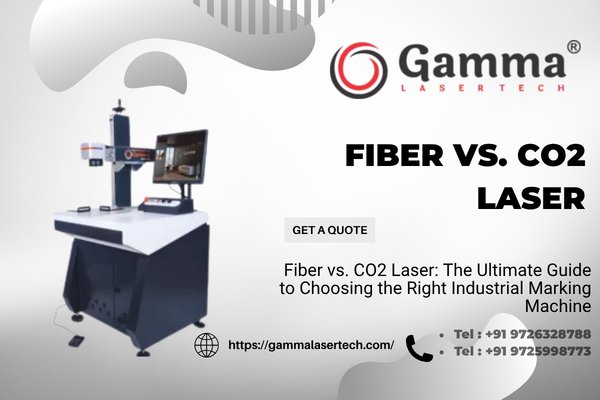
In the fast-paced world of industrial manufacturing, precision is not just an advantage—it is a requirement. Whether you are in the automotive, electronics, or hardware packaging sector, the quality of your product identification is a direct reflection of your brand’s integrity.
However, a common dilemma arises for many business owners in Ahmedabad and beyond: Should I invest in a Fiber Laser Marking Machine or a CO2 Laser Marking Machine?
While both are “lasers,” they operate on completely different physics and are designed for fundamentally different material sets. Choosing the wrong one can lead to production bottlenecks, poor marking quality, and wasted capital. This guide will help you decode the technology so you can align your purchase with your specific business needs.
Understanding the Physics: How They Differ
The primary difference lies in the wavelength of the laser light produced, which dictates how the energy interacts with your material.
1. Fiber Laser Marking Machines: The Metal Specialist
Fiber lasers operate at a wavelength of approximately 1,064 nanometers. This wavelength is highly efficient at being absorbed by metals and certain hard plastics.
How it works: The laser beam is generated by a fiber optic cable and delivered via a high-speed Galvo head.
Best For: All types of metals (Stainless steel, aluminum, brass, copper, gold, silver) and hard industrial plastics.
Key Advantage: Incredible speed and permanence. Fiber lasers are “maintenance-free” in the sense that they have a very long diode life (often 100,000+ hours), making them the backbone of heavy-duty industrial lines.
2. CO2 Laser Marking Machines: The Non-Metal Specialist
CO2 lasers operate at a much longer wavelength—typically 10,600 nanometers. This wavelength is absorbed perfectly by organic materials.
How it works: The beam is produced by a gas-filled tube (often a CO2 glass tube).
Best For: Wood, acrylic, paper, cardboard, textiles, glass, and some coated materials.
Key Advantage: Unmatched versatility on non-metallic surfaces. If your business focuses on packaging, signage, or intricate engraving on wood or leather, the CO2 laser is your undisputed champion.
The Compatibility Matrix: Where Does Your Business Fit?
To help you decide, look at the primary materials you process daily. If you are a manufacturing firm, you likely fall into one of these two buckets:
| Material Type | Recommended Laser | Why? |
| Stainless Steel / Metal Parts | Fiber Laser | High absorption, creates deep, permanent annealing. |
| Wood / MDF / Plywood | CO2 Laser | Vaporizes organic material cleanly without charring. |
| Acrylic / Plastics | CO2 Laser | Smooth edge finish and precise engraving. |
| Gold / Silver / Jewellery | Fiber Laser | Extreme precision for hallmarking and delicate cuts. |
| Packaging / Paper / Carton | CO2 Laser | Rapid-fire marking on high-speed conveyor belts. |
Why "Industrial Grade" Matters
Whether you choose Fiber or CO2, the architecture of the machine is just as important as the laser source. At Dev Digital Media, we often consult with factories that have invested in “cheap” machines that lack structural stability.
An industrial-grade machine, such as a Close Body Type Laser Marking Machine, offers critical benefits:
Safety: Full enclosure protects operators from reflective glare and fumes.
Stability: Heavy-duty frames prevent micro-vibrations, ensuring the laser hits the exact same spot every single time.
Integration: Industrial machines are designed to sync with your existing PLC or assembly line sensors, allowing for “on-the-fly” marking as products move down the line.
Troubleshooting and Maintenance: The Hidden Cost of Ownership
Many buyers forget to look at the “hidden” costs.
Fiber machines generally require very little maintenance beyond keeping the lens clean and the cooling fan dust-free.
CO2 machines require a bit more attention. You must monitor the water cooling system (using a chiller) to ensure the glass tube doesn’t overheat, and periodically check your beam alignment.
If you are currently running a production line and noticing inconsistent results, the issue might not be your laser type, but your maintenance cycle. We always recommend keeping a stock of essential laser marking machine spare parts on hand—such as replacement lenses and mirrors—to ensure that if a component fails, your production line isn’t down for a week waiting for a delivery.
Making the Final Decision
If your goal is permanent traceability on metal components (like automotive parts or medical devices), a Fiber Laser Marking Machine is the only logical choice. It provides the contrast, speed, and durability that industrial standards demand.
If your goal is versatility in branding, cutting, or packaging (like custom boxes, signage, or acrylic work), a CO2 Laser Marking Machine offers the flexibility you need.
Still unsure which machine will deliver the best Return on Investment (ROI) for your specific workshop? We understand that every manufacturing setup is unique.
Explore our full range of professional equipment:
For metal and high-speed industrial marking: View Industrial Fiber Laser Machines
For wood, acrylic, and non-metal applications: View CO2 Laser Engraving Machines